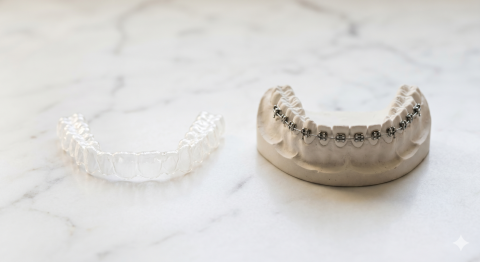
If you’re considering straightening your teeth, you’re likely weighing two main options: Invisalign clear aligners or traditional metal braces. Both are proven orthodontic solutions. Both can produce excellent results. But they work differently, suit different patients, and come with different trade-offs that matter in real daily life.
This guide walks through every major difference — appearance, comfort, effectiveness, cost, and candidacy — so you can have an informed conversation with your dentist. If you’re in Rego Park, Forest Hills, Jackson Heights, Elmhurst, or the surrounding Queens area, Affordable Dental Care PC offers Invisalign treatment for both adults and teens.
How Each Treatment Works
How Invisalign works
Invisalign uses a series of custom-made, removable clear plastic trays — called aligners — that gradually shift your teeth into the desired position. Each set of trays moves your teeth a small amount, and you switch to the next set approximately every one to two weeks. The aligners are made from a patented thermoplastic material called SmartTrack®, which fits snugly over the teeth and applies gentle, consistent force.
Before treatment begins, a digital scan of your teeth is used to create a 3D treatment plan showing the projected movement of your teeth at every stage. You can see a simulation of your results before a single tray is made. Aligners are removed for eating, drinking anything other than water, and brushing and flossing.
How traditional braces work
Traditional metal braces use brackets bonded to each tooth, connected by archwires that are periodically tightened by the orthodontist. The tension in the wire applies constant pressure that moves teeth gradually into alignment. Unlike Invisalign, braces are fixed in place and cannot be removed until the end of treatment. Adjustments are made at appointments typically every four to six weeks.
Modern braces are significantly more comfortable and lower-profile than older generations, and ceramic braces — which use tooth-colored brackets — are an option for patients who want a less visible fixed appliance.
Invisalign vs. Traditional Braces: Side-by-Side Comparison
| Feature | Invisalign | Traditional Braces |
|---|---|---|
| Appearance | Nearly invisible when worn; clear plastic trays | Visible metal or ceramic brackets and wires |
| Removability | Removable for eating, drinking, brushing | Fixed in place for the entire treatment period |
| Diet restrictions | None — remove trays before eating | Avoid hard, sticky, and crunchy foods throughout treatment |
| Oral hygiene | Brush and floss normally after removing trays | Requires extra care to clean around brackets and wires |
| Comfort | Smooth plastic; no brackets or wires | Brackets and wires can irritate cheeks and lips |
| Compliance required | Must wear 20–22 hrs/day for results | Fixed; no compliance issue once placed |
| Treatment range | Best for mild to moderate misalignment | Effective for mild to severe, including complex bites |
| Visit frequency | Every 6–8 weeks for checkups | Every 4–6 weeks for adjustments |
| Typical duration | 6–18 months for most adult cases | 18–24 months for comparable cases |
| Cost | Comparable to braces; varies by case | Comparable to Invisalign; varies by case |
| Insurance coverage | Often covered if plan includes orthodontics | Often covered if plan includes orthodontics |
Who Is a Good Candidate for Invisalign?
Invisalign works best for adults and teens with mild to moderate orthodontic concerns. You may be a strong Invisalign candidate if you:
- Have mild to moderate crowding, spacing, overbite, underbite, or crossbite
- Want a discreet treatment option that fits into a professional or social lifestyle
- Are disciplined enough to wear the aligners 20 to 22 hours per day consistently
- Have fully developed teeth and jaws (typically age 12 and older)
- Want to be able to eat and drink without restrictions during treatment
- Want to see a digital preview of your projected results before committing to treatment
The key to Invisalign’s success is patient compliance. The aligners only work when they are being worn. Patients who remove them for too many hours per day — or who forget to switch to the next set on schedule — will extend their treatment time significantly. If you have concerns about your ability to stay consistent, this is worth discussing honestly with your dentist during the consultation.
Patients interested in Invisalign may also want to explore clear aligner options more broadly, as Invisalign is the most well-known brand but not the only system available. Your dentist can help you understand the differences.
Who Might Be Better Off With Traditional Braces?
Traditional braces are not an inferior option — they are simply a different one, and they remain the more effective choice for certain clinical situations. Braces may be recommended over Invisalign if you:
- Have severe crowding or spacing that requires more precise tooth movement than clear aligners can reliably achieve
- Have significant bite issues such as a severe overbite, underbite, open bite, or crossbite that requires coordinated jaw movement
- Have rotated or tipped teeth that need more complex, multi-directional correction
- Are concerned about your ability to comply with 20–22 hours of daily aligner wear
- Want a treatment that requires no daily decision-making or discipline around wear time
It is also worth noting that some patients start with Invisalign and transition to braces partway through, or vice versa. In certain complex cases, a combination approach is used. The right plan depends on your specific teeth, bite, and goals — not on a general preference for one product over another.
What About Teens?
Teens are candidates for both treatment options, but the choice often comes down to maturity and lifestyle. Invisalign offers a Teen version of its system that includes several features designed specifically for younger patients:
- Blue compliance indicators on each aligner tray that fade from blue to clear as the tray is worn, helping parents and the dentist verify that aligners are being worn as directed
- Replacement aligners included in case trays are lost or damaged (a common concern with younger patients)
- Treatment planning that accounts for teeth that may still be erupting during the course of treatment
Traditional braces, on the other hand, require no daily discipline around wear time because they cannot be removed. For some teens and parents, this is actually the more practical choice — there is nothing to remember, nothing to lose, and no temptation to skip wearing them during inconvenient moments.
Both options work well for teenagers. The right choice depends on the teen’s specific orthodontic needs, their level of responsibility, and the family’s priorities. A consultation will help clarify which is the better fit.
Cost: What to Expect
One of the most common misconceptions about Invisalign is that it is significantly more expensive than traditional braces. For many cases, the costs are actually quite comparable. Both treatment options vary widely in price depending on:
- The complexity of the case and the amount of correction needed
- The length of treatment
- The specific provider and their location
Many dental insurance plans that include orthodontic coverage apply those benefits to Invisalign the same way they would apply them to traditional braces. If you have orthodontic coverage, it is worth checking with your insurance provider about what is included.
At Affordable Dental Care PC, we provide a detailed cost estimate during your Invisalign consultation, and we accept CareCredit and other flexible payment options to help make treatment accessible. We also encourage patients to check our current patient offers before their first visit.
How to Decide: The Right Starting Point
The most important step is a consultation with a qualified dentist who can evaluate your specific situation. The choice between Invisalign and traditional braces is not a matter of which one is generally better — it is a matter of which one is better for your specific teeth, bite, lifestyle, and goals.
During your consultation at Affordable Dental Care PC, Dr. Pinkhasova will:
- Examine your teeth and bite with X-rays and digital imaging
- Discuss your alignment concerns and what you want to achieve
- Explain which treatment options are clinically appropriate for your case
- Walk through the expected timeline and cost for each option
- For Invisalign candidates: generate a digital simulation of your projected results
Many patients who come in expecting to need braces are surprised to find they are good Invisalign candidates, and vice versa. The clinical evaluation is what determines the right plan — not marketing or preference alone.
If your smile goals go beyond straightening — for example, if you’re also interested in whitening, veneers, or bonding — ask about a full smile makeover consultation. Our cosmetic dental team can discuss how orthodontic treatment fits into a broader plan to improve the appearance and health of your smile.
Frequently Asked Questions: Invisalign vs. Braces
Q: Is Invisalign as effective as traditional braces?
A: For mild to moderate alignment issues, Invisalign is just as effective as traditional braces when aligners are worn as directed — 20 to 22 hours per day. For more complex cases involving significant bite correction or severe crowding, traditional braces may provide greater precision. A consultation will determine which approach is right for your case. Visit our Does Invisalign Really Work? page for more detail.
Q: How long does Invisalign take compared to braces?
A: Treatment time depends on case complexity. Invisalign for mild to moderate cases typically takes 6 to 18 months. Traditional braces for similar cases often take 18 to 24 months. Complex bite correction with either method can take longer. Your dentist will give you a personalized estimate at the consultation.
Q: Can adults get Invisalign, or is it just for teenagers?
A: Invisalign is available for both adults and teens, and adults make up a significant portion of Invisalign patients. There is no upper age limit. Adults often prefer Invisalign precisely because it fits discreetly into professional and social settings. A dental evaluation will confirm whether you are a candidate.
Q: Do braces or Invisalign hurt more?
A: Both cause pressure and discomfort when teeth are actively shifting — at the start of treatment and whenever the alignment is adjusted or a new tray set is introduced. Traditional braces can also cause irritation from brackets and wires rubbing against soft tissue. Invisalign trays are smooth plastic with no brackets or wires, which most patients find more comfortable. Both types of discomfort are manageable with over-the-counter pain relief.
Q: Is Invisalign more expensive than braces?
A: The cost of Invisalign and traditional braces is often comparable for similar cases. Both vary based on case complexity, treatment length, and provider. Insurance plans with orthodontic benefits generally apply to both options. At Affordable Dental Care PC, we provide a full cost estimate during the consultation and accept CareCredit and other payment options. View our current offers.
Ready to Explore Invisalign in Rego Park, NY?
Affordable Dental Care PC offers Invisalign treatment for adults and teens throughout Queens — including Rego Park, Forest Hills, Jackson Heights, Elmhurst, and Kew Gardens. Schedule a consultation to find out whether Invisalign or another option is the right fit for your smile goals.
Call us: (718) 897-3434
98-120 Queens Blvd Ste 1H, Rego Park, NY 11374
Learn more: Invisalign Dentist in Rego Park · Clear Aligner Options · Current Patient Offers